The Triangular trade.
Slavery has existed since the beginning of civilizations where the growth of cultivation and warfare brought about injustices that allowed the unfortunate possibility to abduct and keep men, women and children as slaves for domestic, laborious, agricultural, entertainment, or sexual services. It should be noted that many despised slave-owning and attempts were made to free slaves, for instance, the Essenes and the Therapeutae1.
Slave trading, particularly in the Mediterranean region (around 1000 – 1500 CE) became big business and thousands of slaves served a variety of purposes and services. Since, slave trading bore no barriers and spread to other regions of the world.
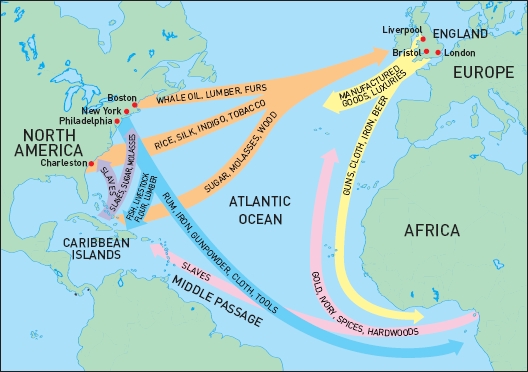
The Triangular trade was an international network linking the economies of the Americas, Africa, and Europe and transported approximately 25 to 30 million enslaved men, women, and children. The Transatlantic slave trade itself moved approximately 15 to 18 million captive slaves, excluding the millions that died en route, during wars, raids of capture, imprisonment in the barracoons, or forced march to the trading posts and assembly centres, and during the “Middle Passage” (transatlantic crossing); it was estimated that for every captive about five others died.
The triangular trade route began with ships leaving Western Europe with weapons, gun powder, beer and rum, textiles, and other such manufactured goods that would be traded for human beings. Next, the captured humans who were now slaves were shipped to the Americas where they would be sold throughout the continent. The last step involved the ships returning with agricultural products made by the captive slaves as well as cotton, sugar, wood, and tobacco among other products. The entire operation lasted approximately 18 months and the major trading countries were England, France, Netherlands, Portugal, and Spain.
This type of slavery became a “totalitarian system for economic, political, social and sexual exploitation, based on force, violence and an ideology of racism. A « dialectics of oppression », a system of social death to which it was possible to escape only by running away, manumission or death.” Moreover, the Europeans introduced a new form of slavery called Chattel slavery, in which, “the slave is treated as a piece of property, belonging to his or her owner, and has no rights; the slave is enslaved for life and his/her children are automatically enslaved too; chattel slaves can also be bought and sold just like cattle (from which the word chattel comes)”.
Code Noir
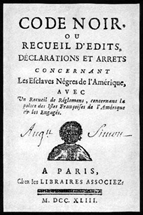
The Code Noir was a French edict by Louis XIV in 1685 that was devised to administer rules and duties on how the relationship between masters/slave owners and slaves (mainly people of African descent) should be governed. The Code Noir had provisions that ensured that the captive slaves by law had no rights and prohibited several conducts that could lead to their escape or freedom such as gatherings and/or assembly with other captive slaves with different masters. In addition, the ‘Code’ had horrifying punishments for retaliatory actions or for attempting to escape the life of slavery such as in Article XXXVIII:
“The fugitive slave who has been on the run for one month from the day his master reported him to the police, shall have his ears cut off and shall be branded with a fleur de lys on one shoulder. If he commits the same infraction for another month, again counting from the day he is reported, he shall have his hamstring cut and be branded with a fleur de lys on the other shoulder. The third time, he shall be put to death.”
|
|
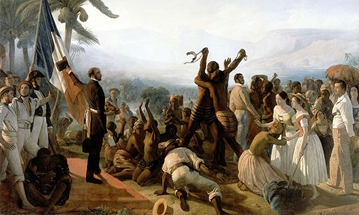
Additionally, the following article punishes masters of free slaves who give refuge to fugitive slaves by way of fines. Other articles such as Article XLIV deems the human beings captured and put into slavery as “community property” and further lays out provisions and conditions of their purchase/sale. Even though the Code certifies that a freed slave shall enjoy the freedoms of ‘freeborn persons’ the manner in, which a slave becomes ‘free’ could only be through a formal declaration by the ‘master’, such as in a will. Moreover, their treatment as ‘freed slaves’ is seriously questionable considering the victimization and stereotyping of black Africans as slaves.


Comments
Post a Comment